

Plantar fasciitis is a clinical condition that presents as sharp pain in the heel that spans from the medial border of the plantar fascia to its insertion at the medial tuberosity of the calcaneus. Pain is provoked with loading and with the initial few steps following periods of inactivity, such as rising from sleep in the morning and toward the end of the day
Despite Planter Fasciitis being a frequently occurring musculoskeletal condition, only 7.1% of patients were evaluated by physical therapists and were primarily seen in private or hospital-based outpatient clinics. Three quarters of all patients seen by a physical therapist were aged 30 to 59 years, with women 50% more likely to be seen than men. Among patients who were evaluated by a physical therapist, 89.5% received a course of supervised rehabilitation and 87.2% received MT as part of their plan of care. A trend of increased MT utilization was observed from 2007 to 2011. These practice patterns may be attributed to greater integration of MT in physical therapy education programs and increasing evidence in the literature. Patients who received MT as part of their care were seen for fewer visits and had lower costs of care.
Physical Therapy Management:
🏥 1. Pain Relief & Acute Management
🔹 Rest & Activity Modification
Avoid prolonged standing, running, and jumping.
🔹 Ice Therapy
Apply ice for 10–15 minutes, 2–3 times daily.
🔹 Taping Techniques
Low-dye taping supports the arch and reduces strain.
🔹 Ultrasound / Electrotherapy
Used in clinic to reduce inflammation and promote healing.
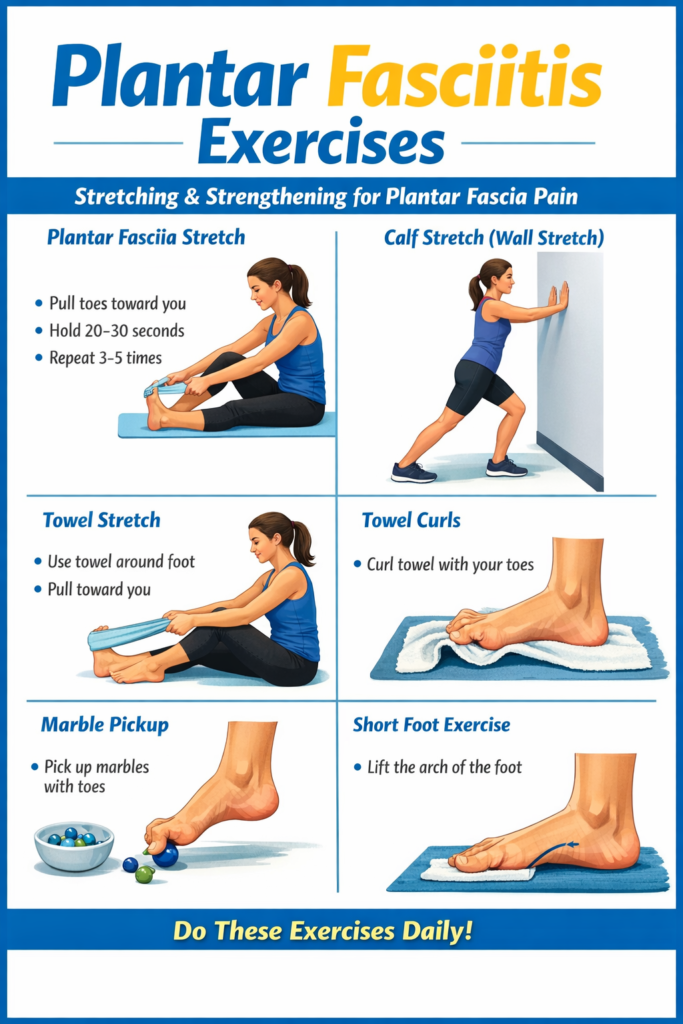
🧘 2. Stretching Exercises
✔️ Plantar Fascia Stretch
- Sit and pull toes toward shin
- Hold 20–30 seconds
- Repeat 3–5 times
✔️ Calf Stretch (Wall Stretch)
- Keep heel on floor
- Lean forward
- Hold 30 seconds
✔️ Towel Stretch
- Use towel around foot
- Pull gently toward body
👉 Stretching is most important in the morning before first step.
💪 3. Strengthening Exercises
✔️ Towel Curls
Pick up towel using toes.
✔️ Marble Pickups
Pick marbles with toes.
✔️ Short Foot Exercise
Strengthens intrinsic foot muscles.
👣 4. Footwear & Orthotics
- Use cushioned shoes
- Avoid flat slippers
- Use heel pads or arch supports
- Custom orthotics if needed
🏃 5. Advanced Rehab (Chronic Cases)
- Eccentric calf strengthening
- Shockwave therapy
- Night splints
- Gait retraining
⏳ Recovery Timeline
- Mild cases: 4–6 weeks
- Chronic cases: 3–6 months
- 90% improve with conservative physical therapy